Let AI extract. Keep the identity decision visible.
Imagine an assistant turns an approved document into a supplier list. Some names differ only in case; others add a word that might matter. Before treating similar names as duplicate records, preserve what the document actually says. An extraction can be wrong before matching even begins.
RapidFuzz is an open-source string-matching library. Use it to propose candidates for review. This walkthrough contains five fictional supplier records and three authored queries; none came from a model or a real company register. The records are deliberately separate in the fixture. We have not established whether names like these would refer to the same entity in the real world.
For a hobby catalog, compare a few invented labels. At work, have the data owner define what counts as the same entity and which evidence is acceptable before adapting the exercise.
Keep originals, then define the comparison.
Keep a stable ID and the exact source name. Store normalized text separately. The default_process helper lowercases text, handles non-alphanumeric characters and trims surrounding whitespace. Those changes may discard distinctions your data needs. Review them explicitly.
Our shortlist uses fuzz.WRatio, explicitly passes utils.default_process, and displays up to three candidates. The extract API returns each original label, score and dictionary key, so separate records retain separate IDs. The limit is a teaching choice, not a validated cutoff. A displayed candidate can still be wrong, and the right record might be missing from the reference list.
The optional AI extraction prompt requests exact strings and source references without merging. We did not run or evaluate it. Check any real extraction against the original document and your service’s data-handling rules before sharing approved data.
Inspect the script and run the fictional records.
Use an existing Python 3.11+ installation. We ran Windows Python 3.13.15 with RapidFuzz 3.14.6, the current release checked October 28, 2026. Choose another empty folder if the dated name already exists.
New-Item -ItemType Directory -Path .\name-practice-2026-10-28 -ErrorAction Stop
Set-Location .\name-practice-2026-10-28
Invoke-WebRequest -Uri "https://jabsystems.io/ai-anonymous/Social/review-the-match-practice.zip" -OutFile .\practice.zip
Expand-Archive -LiteralPath .\practice.zip -DestinationPath .\practice
Get-Content .\practice\name-candidates.py
Get-Content .\practice\name-practice-readme.txt
Read the script before running it. It contains fictional names, computes comparisons and prints JSON; it makes no network or model calls and performs no merges. The following installation needs network access. A virtual environment isolates dependencies, not untrusted code. The project’s Windows requirements describe a Visual C++ runtime prerequisite if DLL loading fails.
python --version
python -m venv .venv
.\.venv\Scripts\python.exe -m pip install rapidfuzz==3.14.6
.\.venv\Scripts\python.exe .\practice\name-candidates.py | Set-Content -Encoding utf8 .\my-results.json
Get-Content .\my-results.json
Compare your report with our recorded output. Your Python version may differ. The package pin records the direct dependency used here; it is not a complete environment lock or a portability guarantee.
The same pair, two different questions.
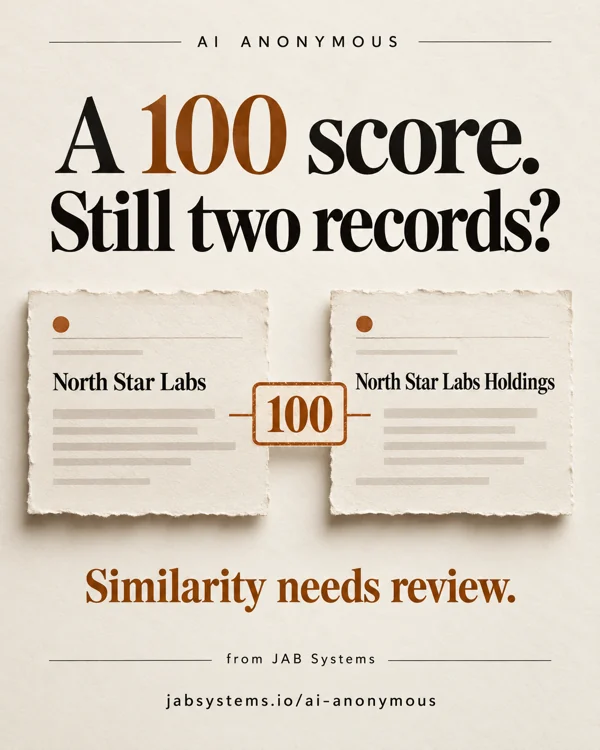
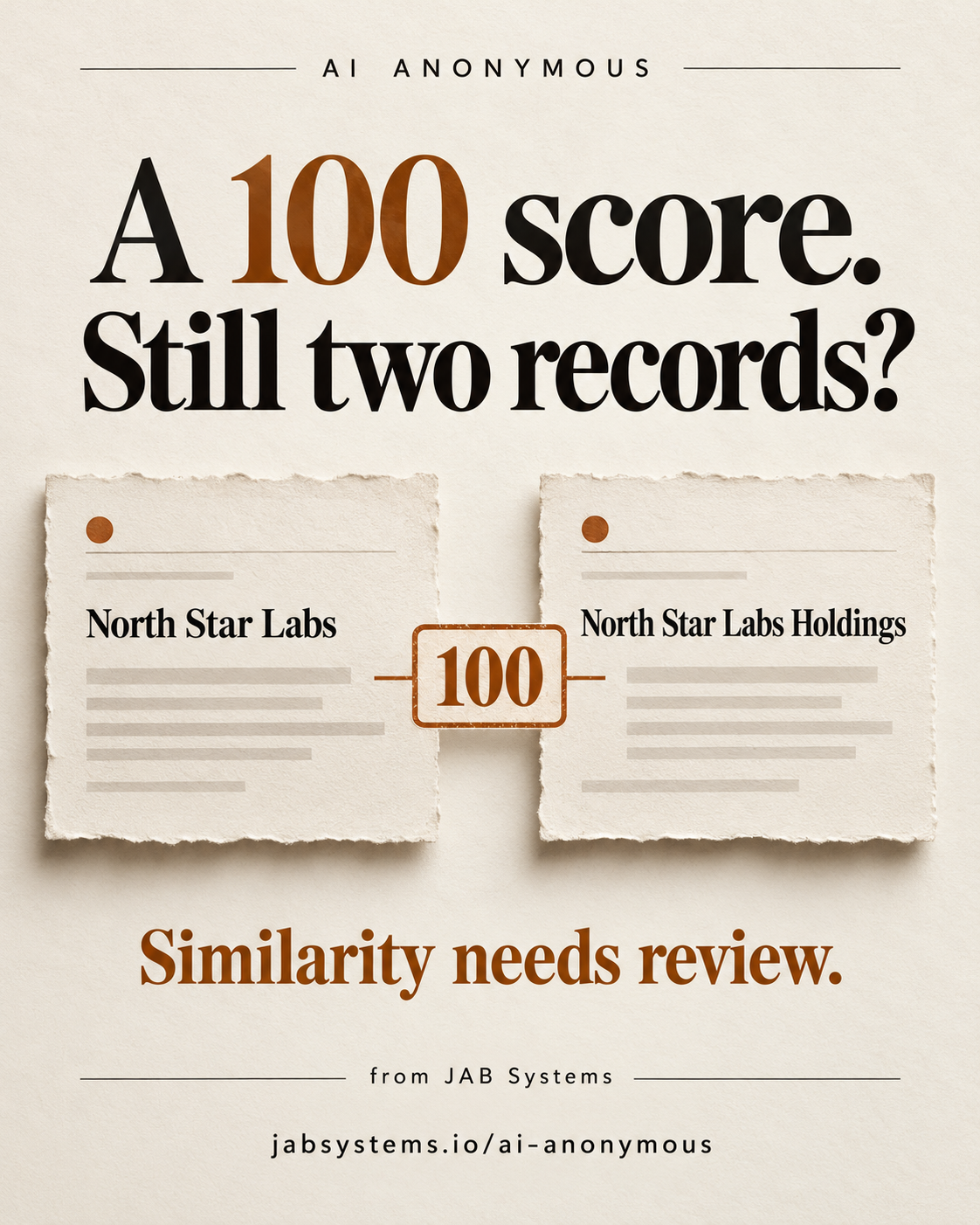
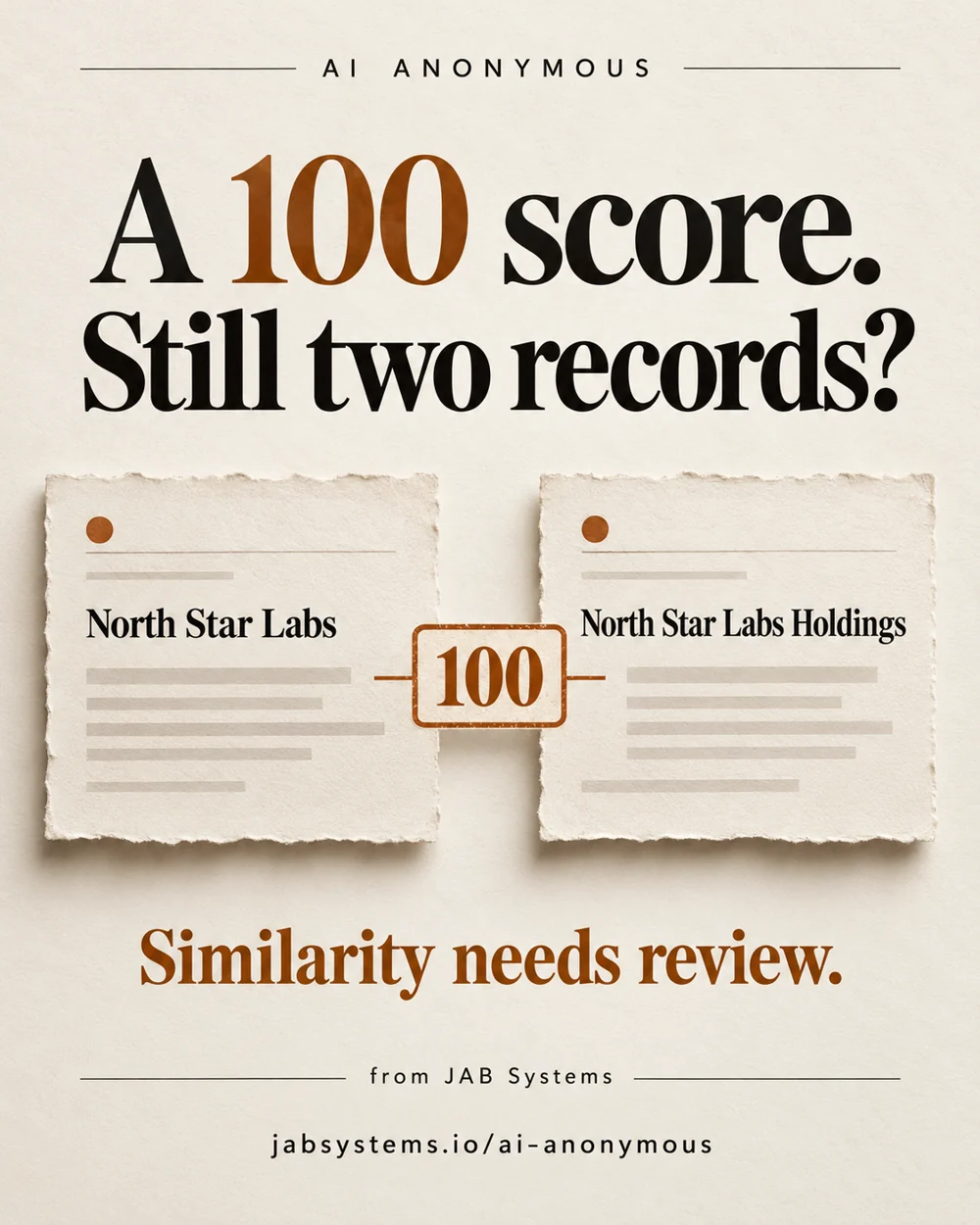
In our local run, North Star Labs versus North Star Labs Holdings returned 100.0 with token_set_ratio and 76.92 with ratio. The strings were not exactly equal. The scorer documentation explains the subset behavior: the short name’s tokens are contained in the longer name. A high score under that rule does not establish identity. Scores from different scorers answer different comparison questions.
Case and punctuation also changed the result. Comparing NORTH STAR LABS! with North Star Labs gave ratio = 32.26 without preprocessing and 100.0 with our explicit processor. The original label stayed in the report. A normalization choice changed the comparison; no supplier identity was verified.
For query Q01, the WRatio shortlist was S01 / North Star Labs / 100.0; S04 / Northstar Labs / 96.55; S02 / North Star Labs Holdings / 90.0. For Q03 / North Star, the displayed S01, S02 and S03 candidates all scored 90.0. Equal-score order follows the input order; the first entry is not a confidence distinction. Q02’s exact label ranked first, but even exact name equality alone does not prove entity identity.
All three queries ended with human_review_required. The script performed zero automatic merges. These numbers describe an authored fixture, not model accuracy, calibrated match probabilities or a measurement of real duplicate frequency.
Return candidates with IDs, not a silent overwrite.
from rapidfuzz import fuzz, process, utils

records = {"S01": "North Star Labs",
           "S02": "North Star Labs Holdings"}
print(fuzz.token_set_ratio(records["S01"], records["S02"]))
# Observed: 100.0. Identity remains unverified.

matches = process.extract(
    "NORTH STAR LABS!", records,
    scorer=fuzz.WRatio,
    processor=utils.default_process,
    limit=3,
)
for original_name, score, record_id in matches:
    print(record_id, original_name, round(score, 2))
This smaller example shows the API shape. The complete downloadable exercise includes all five records, three queries and the recorded comparisons. With dictionary choices, the third tuple element is the record key. Keep it with the original label when you show a reviewer the result.
A score_cutoff can filter candidates, but choosing 90 or 95 does not turn similarity into an identity probability. This guide sets no cutoff and validates no production threshold. Even three tied candidates need evidence beyond their ordering.
Make the review decision explicit.
Inspect each source occurrence, meaningful extra words and available approved identifiers. Ask the data owner which evidence is decisive, then record reviewer, evidence, decision and reason. Allow “unknown” and “no match”. Any later change to a real system needs its own authorized, reversible workflow and audit trail. The checklist keeps those decisions visible.
Before production use, validate missing, blank and non-string values; define language and punctuation rules; test candidate recall and review outcomes with labeled examples from your actual domain. This script only accepts its embedded fictional fixture. It does not implement that production workflow.
Tested: the local authored comparisons and three shortlists, the smaller code example and extracted practice kit. Not tested: AI extraction or review quality, real supplier identity, real datasets, calibrated thresholds, large-scale matching, speed, security, other operating systems or downstream merges. The proposed prompt remains unexecuted. The useful result is a reviewable candidate list with its limitations intact.
Take the candidate-review kit.
Complete exercise · Recorded results · Proposed extraction prompt · Practice README · Review checklist · Practice ZIP
Primary sources checked October 28, 2026. Original AI-generated portrait visually reviewed.